
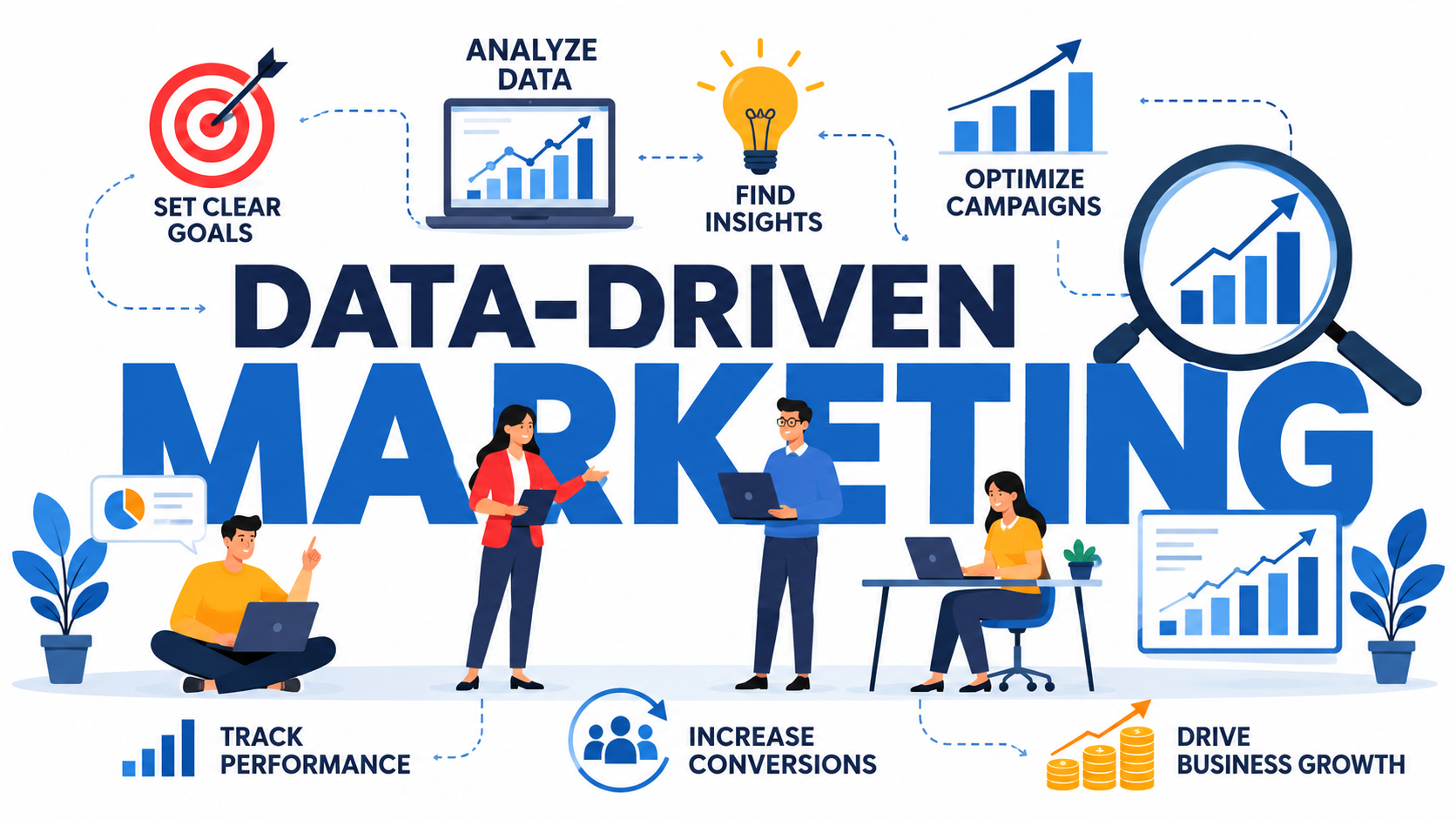
 Using data to guide marketing decisions and increase conversions[/caption]
Data-Driven Marketing: Making Decisions That Actually Convert
Data-driven marketing is what separates teams that guess from teams that know. Most businesses already collect plenty of numbers, including traffic, clicks, open rates and ad spend, yet very few use them to decide anything. Campaigns launch on instinct, budgets get spread thin, and conversion rates stay flat.
This guide explains how data-driven marketing turns scattered numbers into decisions that move visitors toward a purchase. You will get a seven-step framework you can start using this week, the tools worth your attention, the mistakes that quietly wreck results, and a look at how these skills shape a digital marketing career. Whether you run a small business or manage campaigns for clients, the goal is the same: spend less time debating what might work and more time doing what has been shown to work.
What Data-Driven Marketing Really Means
Data-driven marketing is the habit of using evidence, such as customer behavior, campaign results and sales outcomes, to decide what to do next. It does not mean drowning in dashboards or waiting for perfect information. It means asking a specific question, finding the numbers that answer it, and acting on what you learn.
Evidence Over Opinion
Every team has a loudest voice in the room. Maybe it is the founder who loves a certain headline, or the designer who is sure the button should be smaller. Data replaces “I think” with “we saw.” A headline you adore may lose to one you find dull. A channel your boss favors may bring visitors who never buy. When digital marketing decisions rest on evidence, arguments get shorter and results become easier to repeat.
Metrics That Matter and Metrics That Flatter
Not every number deserves your attention. Vanity metrics make a report look good without telling you whether the business is healthier. Followers, impressions and raw pageviews are the usual suspects. Actionable metrics connect directly to revenue:
- Conversion rate: the share of visitors who complete the action you want, whether that is a purchase, a signup or a booked call.
- Cost per acquisition (CPA): what you pay, on average, to win one customer.
- Customer lifetime value (CLV): the total revenue a customer brings over the whole relationship.
- Return on ad spend (ROAS): the revenue earned for every unit of currency spent on advertising.
- Revenue per visitor: a useful blend of traffic quality and conversion performance.
A simple test helps: if a metric went up tomorrow, would you know what to do differently? If not, it is probably decoration.
Why Data-Driven Marketing Improves Conversion Rates
Conversion rarely fails everywhere at once. It fails in specific places, for specific reasons, and data is how you find them.
Find the Leaks in Your Funnel
Imagine a store with 5,000 monthly visitors. Of those, 400 add a product to the cart, 300 begin checkout, and 40 complete the purchase. The homepage is not the problem. The biggest drop happens between starting checkout and paying, where roughly 87 percent of shoppers disappear. That points you toward shipping costs revealed too late, a clumsy payment form, or a lack of trusted payment options. Fixing that single step will almost certainly beat redesigning the homepage.
Mapping your funnel stage by stage, and measuring the drop between each, gives you a ranked list of where effort will pay off most.
Understand Who Is Actually Buying
Averages hide the truth. Split your results by traffic source, device, new versus returning visitors, and location, and patterns appear fast. You may find that mobile visitors convert at half the rate of desktop users, which suggests a mobile experience problem. Or that email subscribers buy at three times the rate of social visitors, which tells you where to invest. Segmentation turns a vague “our conversion rate is low” into a clear, fixable statement.
A Seven-Step Framework for Data-Driven Marketing Decisions
Here is a repeatable process for any team practicing data-driven marketing, from a solo founder to a full department.
Steps 1 to 3: Set the Foundation
Step 1: Define one business goal. Choose a single outcome for the next quarter, such as increasing trial signups by 20 percent or lowering CPA by 15 percent. A clear target tells you which data matters and which can be ignored.
Step 2: Audit your tracking. Bad data produces confident mistakes. Confirm that your analytics platform records the conversions you care about, that campaign links carry consistent UTM parameters, and that your CRM captures where each lead originated. Test the whole path yourself: click an ad, submit a form, and check that every step shows up in your reports.
Step 3: Segment and find the biggest gap. Break results down by channel, device, audience and funnel stage. Look for the largest gap between what is happening and what should be, such as a high-traffic page with a very low conversion rate. That gap becomes your priority.
Steps 4 and 5: Test and Learn
Step 4: Write a hypothesis. A good hypothesis follows a simple pattern: “If we change X, then Y will improve, because Z.” For example: “If we show total shipping costs on the product page, then checkout completion will rise, because shoppers will no longer be surprised at payment.” The “because” forces you to base the idea on something you observed rather than a hunch.
Step 5: Run a clean test. Change one thing at a time. Decide your sample size and duration in advance, and let the test run through at least one full business cycle, usually one to two weeks, so weekday and weekend behavior are both captured. Resist the urge to declare a winner after two good days.
Steps 6 and 7: Scale and Share
Step 6: Roll out winners and record losers. A winning variation should be applied broadly. A losing one is still valuable, so write down what you tried and what you learned. A shared test log saves you from repeating old mistakes and makes onboarding new teammates faster.
Step 7: Report in plain language. Share results as a short story: what we tested, what happened, what we will do next. Hold a brief review every month. Stakeholders who understand the reasoning behind your recommendations will back your next experiment.
Tools That Support Smarter Digital Marketing
Good data-driven marketing does not depend on a long list of software. It depends on a few tools used consistently and tied to real questions.
A Practical Core Stack
- Web analytics: Google Analytics 4 or a privacy-focused alternative to see traffic, behavior and conversions.
- Search data: Google Search Console to learn which queries bring people to your site and which pages underperform.
- Behavior tools: Heatmaps and session recordings, such as Microsoft Clarity or Hotjar, show where visitors hesitate, rage-click or abandon a page.
- Testing platforms: Tools like VWO or Optimizely let you run A/B tests without rebuilding pages by hand.
- CRM and email platform: These connect marketing activity to actual customers and revenue.
- Reporting: A spreadsheet or Looker Studio dashboard that brings your key metrics into one view.
Avoid the Tool Trap
Buying software is not the same as making decisions. Start with free or low-cost options, and add a tool only when you have a question the current setup cannot answer. A small team that uses three tools well will outperform a large one that glances at ten. Every report you build should lead to an action, or it should be removed.
Common Data-Driven Marketing Mistakes to Avoid
Even experienced marketers fall into the same traps. Knowing them in advance saves months of wasted effort.
Acting on Noise
Small samples lie. If a landing page converts 3 visitors out of 40 and the new version converts 5 out of 40, that is not a victory, it is random variation. Stopping tests early because the numbers look exciting is the most common way teams fool themselves. Use a sample size calculator before you begin, and only call a winner when the result is statistically reliable and the sample is large enough to trust.
Ignoring the Why Behind the Numbers
Analytics tells you what happened. It rarely tells you why. Pair your numbers with qualitative sources: short on-site surveys, customer interviews, support tickets, sales call notes and product reviews. If your data shows visitors leaving the pricing page, five customer conversations might reveal in an hour what weeks of dashboards could not. The strongest decisions combine both kinds of evidence.
Collecting Data Without Losing Trust
Privacy expectations and regulations such as GDPR and CCPA have changed how digital marketing teams collect information. Third-party cookies are fading, and customers are more careful about what they share. Focus on first-party data, the information people give you directly through purchases, signups and preference centers, and be transparent about how you use it. Clear consent and honest value in exchange for data protect both your compliance and your reputation.
Building a Digital Marketing Career on Data Skills
If you are early in your professional life, or thinking about switching fields, there is good news. A digital marketing career increasingly rewards people who can read data and turn it into action. Creative instincts still matter, but the people who rise fastest are the ones who can prove what worked.
Skills Employers Look For
Employers hiring for digital marketing roles consistently look for a core set of abilities:
- Analytics fluency: comfort with tools like Google Analytics and the ability to explain what a trend means.
- Experimentation: knowing how to design a test, avoid false positives and document the result.
- Spreadsheet and SQL basics: enough technical skill to pull and clean your own data rather than waiting on someone else.
- Data storytelling: presenting findings so non-specialists understand them and act.
- Business awareness: linking channel metrics to revenue, margin and customer value.
These abilities travel well. Someone who masters data-driven marketing in an e-commerce setting can apply the same thinking to software, services, education or nonprofits.
Build Proof, Not Just a Résumé
Certifications help you learn the vocabulary, but hiring managers want evidence. Start a small project: launch a simple site, run a newsletter, or offer to improve the email campaigns of a local business. Track a baseline, test one change at a time, and write a short case study with real numbers: “We tested two subject lines across 2,000 sends and lifted opens by 18 percent.” A handful of honest case studies tells an employer more than a long list of tool names, and it shows you already work the way strong teams do.
Conclusion: Let the Data Lead
Data-driven marketing is not about collecting more numbers. It is about asking better questions, finding the real leaks in your funnel, testing one change at a time, and acting on what the evidence shows. Teams that follow this discipline stop wasting budget on guesses, and their conversion rates climb because each decision builds on the last.
Start small. Pick one goal, check your tracking, find your biggest funnel gap and run a single clean test this month. Whether you are growing a business or shaping a digital marketing career, the habit of letting evidence guide your next move is the skill that keeps paying off.